Flutina by Fourneax
made in 1835.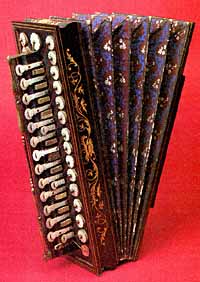 Flutinas
seem to have been amongst the very earliest accordions made and appear
to be a hybrid invention incorporating aspects of both Charles
Wheatstone's concertina and Cyrill Demian's accordion.
Cyrill Demian had invented a free-reeded bellowsed instrument in the late 1820's (patented on May 6th 1829) which had 5 paddle-like buttons that each played a 5-note chord (actually 10 chords: one each for the pushes and one for the pulls). He called this an "accordion" (note the spelling!). Subsequent years saw fancier models with more buttons, chords and nicer workmanship. This type of accordion was being produced up to 1851. These seemed to be used primarily for singing with. Very similar to Indian sruti boxes (a few drone notes or chords, used for singing, played horizontally).
Charles Wheatstones's concertina was a hexagonal bellowsed device described in his 1829 patented of its direct predecessor, the Symphonium. Both sides of his instrument had four rows of studs (now called keys) which each sounded a single note. Though CW wouldn't get around to patenting the concertina under that name until 1844 (when production really started taking off), he did produce a number of concertinas subsequent to his 1829 patent which seem to be used primarily for demonstration purposes in his musical acoustics lectures.
Earliest references to flutinas appear only a couple of years after CW and CD's instruments debuts. About 1831 Pichenot Jeune (in Paris) produced a 16 note (8-key diatonic) flutina that was single-noted, rather than chord-oriented, that had a range of G below middle C to the C two octaves above MC. As this instrument played melodies as opposed to chords, rather than calling it an accord-ion, it was referred to as a clavier melodique. Possibly, this is where we get the word "melodeon". Further refinements were seen in improved range, chords, and fully chromatic instruments. These were produced up to around 1880 when they seemed to have been eclipsed by the "accordeon allemande" or hand-accordion, which was and offshoot that combined the best of both Demians and Pichenots.